Disclaimer: This website should be read in conjunction with relevant legislation and appropriate legal advice.
Guidance on the Working Time (Road Transport) Regulations 2005.
This website provides guidance on the limits on working time provided for in the Working Time (Road Transport) Regulations 2005. It gives general guidance only and should not be regarded as a complete or authoritative statement of the law. Please check with DfT for the latest version.
Readers should be aware that there might be developments in new legislation or case law, which affect the rights of workers. This guidance is subject to ongoing review in the light of practical experience and any updates will be published on the DfT website.
1. Who is Affected by the Working Time (Road Transport) Regulations?
1.1 Main Points
> The Regulations affect drivers and other "mobile workers" who are involved in operations subject to the European drivers' hours rules, or in some cases the AETR, including own-account drivers and agency drivers. Generally, anyone in a vehicle that is required by European legislation to have a tachograph is affected.
> If a worker is only occasionally undertaking activities covered by the European drivers' hours rules (see Section 1.3 - "occasional mobile workers"), they are covered by the Working Time Regulations 1998, as amended (SI 1998 No. 1833 - "the 1998 Working Time Regulations"), rather than these Regulations.
> The Regulations do not affect self-employed drivers until March 2009; provided they fit the definition of self-employed (see Section 1.4 - "self-employed drivers").
1.2 Who is Affected?
Mobile workers are covered by the Regulations if they are involved in operations subject to the European drivers' hours rules or in some cases the AETR. Generally, drivers, vehicle crew and travelling staff of goods vehicles where the maximum permissible weight exceeds 3.5 tonnes or passenger vehicles suitable for carrying more than 9 people including the driver. [1] A worker is anyone who provides work or services under a contract, express or implied. A mobile worker is any worker forming part of the travelling staff (typically drivers and vehicle crew, but also trainees and apprentices) who is in the service of an undertaking which operates road transport services for passengers or the movement of goods. Mobile workers include drivers who work for hire and reward companies or companies with own account operations.
Typically, this means:
> drivers of vehicles with a tachograph in them (unless they have an exemption from the European drivers' hours rules), i.e. goods vehicles over 3.5 tonnes, coaches and inter-urban bus services;
> members of the vehicle crew; and
> any others who form part of the travelling staff.
A number of road transport operations require attendants who must accompany the driver by law, or fulfil a function ancillary to driving (e.g. navigating or crew to accompany abnormal loads), or security staff for high-value goods. Travelling staff may include a range of individuals such as porters in household removals; draymen in brewery delivery movements; conductors on inter-urban buses. These would all be covered by the Regulations.
The Regulations do not apply to:
> mobile workers who are not participating in road transport activities covered by the European drivers' hours rules or in some cases the AETR (e.g. employed taxi drivers, certain van drivers, chauffeurs);
> any drivers, crew, travelling staff who do not come within the definition of "mobile worker" in the Regulations (e.g. a teacher who drives a PSV on a school trip, that is subject to the European drivers' hours rules);
passengers (e.g. construction workers being ferried to a building site would be passengers rather than travelling staff);
> any worker who only occasionally does work which is within the scope of European drivers' hours rules (see Section 1.3);
> self-employed drivers who come within the definition of "self-employed driver" in the Regulations (see Section 1.4).
1.3 Occasional Mobile Workers
The Regulations are primarily for the benefit of the drivers and crew of vehicles participating in road transport activities under the European drivers' hours rules. Drivers and crew who only occasionally participate in such activities are exempt from the Regulations. However, the requirements of the European drivers' hours rules continue to apply, as do the requirements of the 1998 Working Time Regulations.
A mobile worker would qualify for this exemption if:
> they work 10 days or less within the scope of the European drivers' hours rules in a reference period that is shorter than 26 weeks;
> they work 15 days or less within the scope of the European drivers' hours rules in a reference period that is 26 weeks or longer. [2]
In terms of what constitutes a day for the purpose of this calculation, the Department's view is, that in this context, a "day" means a rolling 24 hour period (starting with the commencement of in-scope work). However, this is only the Department's opinion, and ultimately, interpretation of the law remains a matter for the Courts.
Employers of occasional mobile workers may arrange individual reference periods (if a relevant agreement is in place), or operate the default in such instances - remembering, of course, that if a worker happens to exceed the above limits then they will be considered a "mobile worker" for the purposes of the Regulations, and any calculation of working time will be retrospective (i.e. include all hours worked from the start of the reference period).
1.4 Self-Employed Drivers
Self-employed drivers (as defined under the Regulations) are excluded from all the requirements until March 2009. However, the definition of "self-employed driver" under the Regulations have been tightly drawn. Therefore, those who might be classed as self-employed for the purpose of the Employment Rights Act 1996 or the 1998 Working Time Regulations are not necessarily classed as self-employed under these Regulations. Nor is the test, the same as applied by HM Revenue and Customs. As a consequence, only a limited number of drivers are likely to be regarded as a "self-employed driver" for the purposes of the Regulations.
"Self-employed driver" means anyone whose main occupation is to transport passengers or goods by road for hire or reward within the meaning of Community legislation under cover of a Community licence or any other professional authorisation to carry out such transport, who is entitled to work for himself and who is not tied to an employer by an employment contract or by any other type of working hierarchical relationship, who is free to organise the relevant working activities, whose income depends directly on the profits made and who has the freedom, individually or through a co-operation between self-employed drivers, to have commercial relations with several customers" (Regulation 2 of SI 2005 No. 639)
Key considerations are that:
> a self-employed driver must have an operator's licence;
> the amount of control that the driver has over their work is a key point, as is their reliance on profits to provide them with an income;
> if the worker is restricted (either implicitly or explicitly) from working for another client/customer, then they would be covered by all the requirements of the Regulations;
> in addition, most agency workers would not count as a self-employed driver, because they are normally paid at a fixed rate. Once they accept a job, an agency worker is not free to organise their working activities.
For the purpose of the Regulations, drivers who are partners in a firm or who have limited liability will be treated no differently to sole traders. Providing they have an operator's licence and meet the other requirements under the Regulations, then they can class themselves as a self-employed driver.
1.5 Working for Employment Businesses and/or via Employment Agencies
Mobile workers who obtain work via an employment business or an employment agency are subject to terms and conditions under their contract with the business or agency. Workers are normally paid directly by an employment business, as part of their contractual relationship. The employment business is responsible for monitoring their work and keeping appropriate working time records. However, some workers who obtain work via employment agencies (on a fixed or short-term contract) are paid directly by and have a contract with the hirer. Under those circumstances, the hirer monitors working time and maintains adequate records. Where no written contract of employment exists, whoever directly pays the worker in respect of work undertaken will be regarded as the employer for the purposes of the Regulations. Some workers register with and work for, more than one employment business.
The calculation of working time must include work performed for all employers who undertake road transport activities under the European drivers' hours rules, during the reference period, so the worker must inform all such employers in writing (or whoever is responsible for keeping records), of the hours worked for another employer (See Section 2.5 - "working for two or more employers or another organisation"). Agencies and Employment businesses are not generally allowed to keep original tachograph charts or electronic data. If tachograph records are used to monitor working time, then the agency/business should copy the chart before returning it to the client, otherwise, they will have to ask the client for a copy of the chart (or for a summary of the information on the chart). See Section 6 "Record Keeping" for full details on record keeping requirements.
Frequently asked questions:
Q: If a driver is normally deemed to be self-employed (for example for Inland Revenue purposes), but fails to meet the criteria of "self-employed driver" under the Regulations, is he/she covered by provisions under any other working time legislation (e.g. the 1998 Working Time Regulations)?
A: A driver does not necessarily become an employee for the purposes of other employment legislation, because he/she fails to meet the definition of "self-employed driver" under the Regulations. The definition of "self-employed driver" under the Regulations does not set a precedent, in relation to other UK employment legislation. [1] More information about Regulation (EC) No 561/2006 - who is covered, the exemptions and exceptions, can be found in DfT.s drivers. hours guidebooks (GV262 & PSV375), under the road freight section of the DfT website at www.dft.gov.uk [2] Whilst 26 weeks is the maximum reference period under the Regulations, the 1998 Working Time Regulations allow for 12 month reference periods to be used.
2. What Counts as Working Time?
2.1 Main Points
> Working time is not attendance or shift time. It does not include travelling between home and work (however, it should be noted, that in certain circumstances such periods may count as "other work" under the separate European drivers' hours rules), lunch breaks, other breaks, periods of availability, evening classes or day-release courses.
> Working time includes job-related training associated with normal work and training that is part of the company's commercial transport operation.
> Work carried out for another employer (who undertakes road transport activities within scope of the European drivers' hours rules) counts towards the total working time performed by the mobile worker.
> Voluntary work and activities performed by mobile workers who are part-time retained firefighters, special constables and members of the reserve forces should not be counted towards these limits.
Employers Check
> Identify activities that count as working time and those which count as periods of availability.
> Ask workers to confirm any working time they have performed for another employer.
2.2 What is Working Time?
The Regulations define working time as the time from the beginning of work, during which the mobile worker is at the workstation (typically this means the driver's cab - but see glossary for a fuller definition of this and other terms) at the disposal of the employer and exercising his functions or activities - that is to say:
a) the time devoted to all road transport activities including:
> Driving;
> Loading/unloading;
> Training that is part of normal work and is part of the commercial operation;
> Assisting passengers boarding/disembarking from vehicle;
> Cleaning, maintenance of vehicle;
> Work intended to ensure safety of vehicle and its cargo and passengers (e.g. monitoring loading and unloading - including daily defect check and report);
> Administrative formalities or work linked to legal or regulatory obligations directly linked to the specific transport operations underway.
b) time devoted to other activities:
> Time during which the mobile worker cannot freely dispose of his/her time and is required to be at the workstation (typically this means the driver's cab - but see glossary for fuller definition of this and other terms) ready to take up normal work, with certain tasks associated with being on duty (e.g. working in the warehouse, or in an office or doing other activities for the employer);
> Waiting periods where the foreseeable duration is not known in advance, by the mobile worker, either before departure or just before the start of the period in question.
Working Time does not include:
> Routine travel between home and their normal place of work.
> Rest and breaks when no work is done.
> Periods of availability (see below).
> Evening classes or day-release courses.
> Voluntary work or time spent as a Retained Fire Fighter, a Special Constable, or member of the Reserve Forces).
2.3 What is a Period of Availability?
Generally speaking a period of availability (PoA) is waiting time, the duration of which is known about in advance by the mobile worker. Under the Regulations, these periods have to meet the following criteria:
> A mobile worker should not be required to remain at his workstation;
> (But) he must be available to answer calls to start work or resume driving on request; and
> The period and the foreseeable duration should be known in advance, by the mobile worker, either before departure or just before the start of the period in question.
Examples of a PoA include the time when accompanying a vehicle being transported by boat or train; or time spent waiting at frontiers; or delays due to traffic prohibitions. When driving as part of a team, when not driving, unless the mobile worker is taking a break or performing other work (e.g. navigation), a PoA also includes time spent sitting next to the driver while the vehicle is in motion. Other travelling staff may also count travelling time as a PoA, provided they are not performing any other work. Like breaks and rest periods, a PoA can be taken at the workstation. Providing the mobile worker has a reasonable amount of freedom (e.g. he can relax and read), for a known duration, this would satisfy the requirements for a PoA. Where the mobile worker knows about a delay in advance, but it is deemed prudent that the driver should remain in the cab for reasons of security or safety, this should not in itself, disqualify this delay being recorded as a PoA. Typical examples might include waiting at a site that is unsafe for pedestrians or staying in a vehicle carrying high value goods or cash. Mobile workers do not need to be formally notified about a PoA and its duration in advance. It is enough that they know about it (and the foreseeable duration), in advance. A PoA does not apply to delays where the mobile worker has to continue working. For example, where a driver is diverted due to a road closure, he/she would still be driving. Normally, delays due to congestion would also count as working time because the driver would be stopping and starting the vehicle. If a mobile worker is monitoring a discharge from the vehicle (e.g. petrol at filling station), this time will also count as working time. There are no requirements as to the minimum and maximum length of a PoA.
Examples of a PoA:
> When a mobile worker experiences a delay at a regional distribution centre or depot, waiting for someone to load or unload their vehicle, if they know about the length of the delay at the start of the period (because someone has told them; because they have arrived too early for their slot; or because they always experience a delay at one of their regular customers).
> If a mobile worker typically experiences a 1 hour delay at one of their regular customers, then this would count as a PoA. However, if they were to unexpectedly experience a 2 hour delay, then the second hour would count as working time. Unless the mobile worker was notified, before the end of the first hour, that a further hours delay was expected, in which case the second hour would also count as a PoA.
> Where a mobile worker reports for work, is informed that they are not required to undertake any duties for a specified period (albeit, they need to remain on site to answer calls and be ready to take up work), but is free to wait in the canteen or rest facility.
> If the vehicle breaks down and the mobile worker is told how long it will take to be rescued.
> Unless doing some other work (e.g. navigating), a relief driver who is travelling as a passenger would count this time as a period of availability. This time (or a part of it) could also be counted as a break - but would need to be recorded as such.
> Traffic prohibitions that would count as a PoA include, for example, where the police have delayed the movement of an abnormal load for a set period of time, or where vehicles are banned from city centres during specified hours, and the driver has to park the vehicle and wait.
2.4 What is a Week?
The working week must start at 00.00 hours on Monday, and finish at 23.59 hours on Sunday.
2.5 Working for Two or More Employers or Another Organisation
For the purposes of the Regulations, working time is restricted to work for employers for whom a mobile worker carries out any in-scope road transport activities (i.e. work covered by the European drivers' hours rules). It includes both road transport activities and any other work for such employers (for instance when a driver also works in an employer's warehouse).
It does not include work performed for employers who are not involved in road transport activities (for instance bar work). However, such work would count as part of the "daily working period" for the purposes of determining compliance with the separate European drivers' hours rules (i.e. bar work will impact on when you can work and how much work you can do). Similarly, the Regulations, do not apply to workers who work for employers who undertake some road transport activities if the worker in question is not actually involved in such activities. In such cases, the worker would be subject to the requirements of the 1998 Working Time Regulations. If an employee works for two or more employers, then the weekly working time is the combined total of the hours worked (excluding breaks, rest and periods of availability) for all the employers. The mobile worker must tell their employer(s) in writing, of any time worked for another employer. However, time spent on voluntary activities (e.g. driving a vehicle in a carnival/gala days) does not count towards the working time limits.
In addition, time spent performing activities for the emergency services or Armed Forces (such as being a retained fire fighter, special constable, and duties performed whilst being a member of the reserve forces (Territorial Army etc)) should not count towards the limits under the Regulations. Nevertheless, employers should bear these other activities in mind when deciding how much work (and what type), can be performed. Workers should not do any work that would compromise road safety or impair the health of the employee. In addition, all the rest requirements and limits under the European drivers' hours rules still apply.
2.5 Change of Employer During Reference Period
Where a mobile worker ends employment with one employer, who operates road transport services for passengers or the movement of goods, during a reference period, and commences work for another, all relevant hours worked for the previous employer should be included in the calculation of working time for the reference period in question. In such instances, employers must ask the new mobile worker in writing for an account of time spent working elsewhere. The mobile worker must declare this information in writing.
Frequently asked questions:
Q: Can a worker be paid for periods of availability - even if these periods do not count towards the working time limits under the Regulations?
A: The basis for calculating the amount that a worker is paid by their employer should be determined by their terms and conditions of employment. The Regulations are simply concerned with the number of hours that workers can spend on certain activities which fall within the definition of 'working time' for the purposes of the Regulations. The Regulations do not say what a worker can or cannot be paid for.
Q: If a worker is given some work halfway through a PoA, does any of the time count as PoA?
A: Yes, the first part counts as PoA. For example, if a worker is told to wait for 1 hour but is subsequently told to start work after 30 minutes, the PoA should be recorded as 30 minutes.
Q: What if my employer asks me to record a PoA for longer than I have actually taken?
A: This is illegal and should be reported to VOSA (See Section 7.3 - "Enforcement")
Q: While the vehicle is in motion, the travelling crew can normally count time spent travelling as a PoA. Can part of this time also count as a break?
A: Yes, providing they are not doing other work; they comply with all the requirements for a break and record the time as a break on their tachograph.
3. Weekly Working Time Limits (And How To Calculate Them)
3.1 Main Points
> Workers may not exceed an average 48 hours working time a week over the reference period, nor may they exceed 60 hours working time in a single week (a week always starts at 00.00 on Monday morning).
> Workers covered by the Regulations cannot opt-out from the average 48-hour weekly limit.
The average weekly working time should be calculated over 17 weeks (some methods allow 18 weeks). This can be extended to a maximum of 6 months (26 weeks) under a relevant agreement (see section 7.1 - "relevant agreements").
> Enforcement will be on the basis of a fixed reference period, but companies are free to manage working time on the basis of rolling reference periods. The important thing is that where fixed periods are used, the start date is established in advance so that compliance can be monitored.
> The average 48-hour weekly limit can be monitored using a rolling reference period over 17 weeks like the existing period under the 1998 Working Time Regulations, as amended - see annex E for details. A collective or workforce agreement is only required under this method if the reference period exceeds 17 weeks.
> Employers and employees may agree on the reference period to be used (see Section 7.1 - "relevant agreements"). In the absence of such an agreement, employers can either use option 1 (fixing dates by the calendar) or option 2 (the rolling method) - see Section 3.6 for details of the options.
> Statutory annual leave entitlement, sick leave, maternity, paternity, adoption or parental leave cannot be used to bring down the average weekly working time.
> Employers must enter 48 hours for each week of statutory leave and 8 hours for each day of statutory leave. Alternatively, if using the rolling reference period, leave can be offset using the method used under the 1998 Working Time Regulations (see Annex E for details).
Employers check:
> Decide on your preferred option (fixed or rolling) to monitor compliance with the average 48-hour working week.
> If a longer reference period or different start/finish dates are needed, consider a collective or workforce agreement with the employees.
> If an agreement is reached, make sure the reference period does not exceed 26 weeks.
3.2 Limits
If you are an employer, you must ensure your workers do not work more than an average 48-hour week or more than 60 hours in any single week. Unlike other working time legislation, mobile workers cannot opt-out from these weekly limits.
3.3 What is the Reference Period and When Does it Start?
Normally, the number of hours worked each week should be averaged out over a continuous 17 week period. However, the "default calendar option" referred to below, includes some 18 week periods. This is to allow 3 reference periods to be accommodated into one calendar year. In addition, this period can be extended up to 26 weeks if there is a relevant agreement in place (see section 7.1 - "relevant agreements"). This continuous 17 or 26 week period is used to calculate the average weekly working time and is known as the 'reference period'. The working week must start and finish at 00.00 on Monday morning. So the starting point for calculating the average 48 hour and 60 hour weekly limits should always be 00.00 on Monday morning.
3.4 Calculating Average Weekly Working Time
The average weekly working time is calculated by dividing the number of hours worked by the number of weeks in the reference period. It is possible to work up to 816 hours in a 17 week reference period, 864 hours in an 18 week period and up to 1248 hours in a 26 week period.
Example 1:
A worker has a standard working week of 40 hours and does overtime of 12 hours a week for the first 10 weeks of a 17-week reference period. No leave is taken during the reference period. The total number of hours worked is:
17 weeks of 40 hours and 10 weeks of 12 hours of overtime (17 x 40) + (10 x 12) = 800
Therefore the average (total hours divided by the number of weeks) is: 800 / 17 = 47.1 The 48-hour average and the 60-hour cap have been complied with.
3.5 Calculating the Average when Leave is Taken
You cannot use statutory annual leave, sick leave, maternity, paternity, adoption or parental leave in order to reduce the average working time performed during the reference period. So when calculating the average weekly working time, any maternity, paternity, adoption, parental leave, sick leave - as well as the statutory paid annual leave entitlement must not affect the result of your calculation. This is a little more complicated, but it can be done by adding 48 hours for each week of annual leave that is taken and adding 8 hours for each additional leave day that is taken. So if someone takes 1 week off on leave and takes 2 days additional days leave over a 17 week reference period, then you add a notional 48 hours + 16 hours to bring the total working time up to the equivalent of 17 weeks. The total working time is then divided by 17 to find the average.
Example 2:
During a 26 week reference period, a driver works 35 hours for 13 weeks and 60 hours for 10 weeks + 1 day (for 9 hours). The remaining period, (2 weeks 5 days) is taken as leave during this period. The total hours worked in the reference period is:
(35 x 13) + (60 x 10) + (1x9) = 1064 hours worked in 23 weeks + 1 day
Add 2 x 48 hours for the 2 weeks leave and add 8 hours per day to bring the time worked up to 26 weeks.
2 weeks x 48 = 96 5 (days) x 8 = 40 1064 + 96 + 40 = 1200
Therefore the average (total hours divided by number of weeks) is: 1200 / 26 = 46 hours The 48-hour average and the 60-hour cap have been complied with.
Note: You should only input 48 hours for one week of leave that starts / finishes at 00.00 on Monday morning. Any other period of 7 consecutive days (e.g. Wednesday to Tuesday) should be worked out on a daily basis).
3.6 Who Decides What Reference Period Should be Used?
The employer and employee may agree, in advance, what reference period should be used. But if no agreement is reached, then the Regulations will require that the employer uses either the first or second option.
The Options:
Whichever method is in place, the employer and worker must know in advance how working time is being monitored and when the reference period starts and when it ends. There are several methods you can use to calculate and monitor compliance with the weekly average. The first two options (basic fixed calendar and the rolling reference period) can be used without the need for a relevant agreement. However, employers will still need to tell their workers about which method they are going to use; in particular they must give written notice if they choose Option 2, the rolling reference period. The third option provides employers with extra flexibility and does require a collective or workforce agreement (section 7.1 - "relevant agreements").
Option 1: Basic fixed calendar
Companies looking for an off-the-shelf approach to complying with the Regulations may like to use this option. It will, in any case, be one of the two approaches open to an employer if no workforce or collective agreement is in place. Default reference periods will begin at 00.00 on the nearest Monday morning on or after 1 April, 1 August and 1 December each year. So for 2007/08 the start and finishing dates for the reference periods are as follows.
2 Apr 2007 5 Aug 2007 (18 week period) 6 Aug 2007 2 Dec 2007 (17 week period) 3 Dec 2008 7 Apr 2008 (18 week period)
At least one of the reference periods each year will contain 18 weeks. When this occurs, the average 48 hour week should be divided by 18 weeks, rather than 17 weeks.
Option 2: Rolling reference period
This is the normal method used under regulation 4(6) of the 1998 Working Time Regulations, for monitoring working time. Under a rolling average, the consecutive reference periods should not result in an average working week in excess 48 hours. For a 17 week reference period for example, this would mean that in addition to the period from 3 April - 30 July 2006 not exceeding the 48 hour average, the period from 10 April - 6 August 2006 should not exceed the average - and so on. Nor indeed should any other consecutive 17 - 26 week period in the weekly record exceed the average 48 hour working week (see Annex E for details). The method of compensating for leave is different under the 1998 Working Time Regulations. Actual working time from outside the reference period is used to offset the statutory leave taken inside the reference period. So if 1 week + 2 days leave is taken within the 17 week reference period, the actual working time from the 18th week + 2 days from week 19 is used offset this leave. For the purposes of these Regulations, employers using this option can choose to offset statutory leave with either method. That is, by using actual working time, or by using the notional figures of 48 hours/8 hours described above.
Option 3: Reference period settled by agreement
This offers additional flexibility for employers and employees via a relevant agreement to have:
> Different start and finish dates for the reference period, and
> Longer reference periods (up to 26 weeks).
For example, three reference periods starting on the nearest Monday on or after 1 May; 1 September and 1 January, could be chosen, or two 26 week reference periods may be agreed. However, whatever start date is agreed, the reference period must begin at the start of the week; from 00.00 on Monday morning (see option 3 - Annex C). A relevant agreement does not have to apply to all the workers in a company. For example:
> Different agreements can be agreed between different groups of workers in the same company (so the start dates and the length of the reference period can vary within the same organisation).
> An agreement may allow different reference periods to apply to certain individuals. For example, it might be better if drivers who work for two employers to have their own reference period.
3.7 Which Method Should I Use?
That depends on your circumstances:
> Option 1: Fixing the reference period could simplify the monitoring and enforcement of compliance. It also gives employers more flexibility; e.g. the worker could work above-average hours for the second half of the first period and the first half of the second period, without breaching the 48-hour limit.
> Option 2: Companies, who are happy using a rolling reference period for existing non-mobile workers, may want to apply the same method for their mobile workers. However, this gives least flexibility for employers.
> Option 3: Workers, who work for two or more employers, may prefer a rolling period or have their own unique fixed reference period.
If an occasional mobile worker exceeds the limit in the definition (see Section 1.3 - "occasional mobile worker"), the simplest method would be to use option 3. Over the reference period that is agreed with the employer, the individual should not exceed an average working time of 48 hours a week, nor exceed the 60 hour limit on working time for any single week during this period. For those who already use the rolling reference period under the main working time rules, employers may find it easier to continue using this for such workers - rather than change the system they currently work with.
3.8 Other Points to Note
If an employee works for two or more employers, then the weekly working time - (i.e. work, excluding breaks, rest and periods of availability) is the working time performed for all employers.
Employers must ask the mobile worker concerned in writing for an account of time worked for another employer and a written record needs to be kept by the employer of any time spent working elsewhere. The mobile worker must declare this information in writing. One approach would be to notify each new and existing employee of this requirement in a letter. Thereafter, this requirement (for an employee to disclose work for another employer) could be set out in a contract of employment, or under a collective or workforce agreement.
If a worker has been working for an employer for less than the full reference period (e.g. 12 weeks), then the average is worked out over the total time since the start of his or her employment. If an employee was previously engaged in road transport activities for his or her previous employer, the average working time must be calculated over the full reference period.
Frequently asked questions:
Q: Can an employer use 2 methods (e.g. the default option for some workers (option 1) and fixed by agreement for another group of workers (option 3)?
A: Yes, as long as employees know which method is being used to monitor their working time.
Q: Can an employer switch methods?
A: Yes, providing his employees agree. If the switch is from one fixed reference period, to another fixed period, care needs to be taken to ensure that working time does not exceed an average 48 hours per week.
Q: Can I use annual leave and sick leave to reduce my average working time?
A: When calculating average working time during a fixed reference period under the Regulations, mobile workers are required to include notional "working time" figures for any statutory annual leave (paid leave under the 1998 Working Time Regulations) sick leave, maternity, paternity, adoption or parental leave that they take. These notional figures are 8 hours per day and 48 hours per week. This means that such leave cannot be used to offset hours actually worked.
Q: Why are we required to add in notional figures for any statutory annual leave that is taken?
A: This arrangement reflects a requirement under the main European Working Time Directive (2003/88/EC) that annual leave should remain neutral for the purposes of calculating any weekly average. This element of the main Directive also applies to mobile workers. It is up to Member States to decide how best to implement this provision in their respective territories. A 48-hour notional figure for a week reflects the maximum average weekly working time allowed. By using this figure, the effect of a week's leave is therefore neutral for the purposes of calculating average working time across a reference period.
Q: If during a 26 week reference period I work maximum 60 hour weeks for 12 weeks, then take the rest of the reference period off as sick, my average working time will exceed 48 hours. What should I or my employer do in this situation?
A: In these circumstances, the employer should keep a full explanation of the reasons for the excess average, with the employee's records.
Q: How does time taken off for jury leave, union duties, disciplinary suspension etc affect the "working time" calculation?
A: The requirement to add-in notional "working time" figures only applies to statutory annual leave, sick leave, maternity, paternity, adoption or parental leave (as mentioned in Section 3.6). The prescribed notional figures do not have to be included for time off for any other reasons (such as jury leave, union duties, or disciplinary suspension).
Q. Can any annual leave above the 4 week statutory annual leave entitlement be used to reduce the hours worked in a week?
A: The requirement to add-in notional figures for annual leave only applies to the four weeks statutory annual leave entitlement provided by Regulation 13 of the 1998 Working Time Regulations. Any leave periods in excess of that statutory minimum (for instance additional contractual entitlements) are not treated in this way. Therefore for the purposes of calculating average working time, the prescribed notional figures do not have to be included for any non-statutory leave.
Q. Are Bank Holidays included in the statutory paid leave entitlement?
A: The Department of Trade and Industry is consulting on plans to make paid leave for bank holidays additional to the statutory annual leave entitlement. Currently, whether bank and public holidays are counted as part of the statutory annual leave entitlement will depend on the contract of employment between employer and employee.
4. Working at Night
4.1 Main Points
> Night time is between midnight and 4am for goods vehicles and 1am and 5am for passenger vehicles.
> If night work is performed, the daily working time should not exceed 10 hours in the 24 hour period in question.
> If a mobile worker does any work during the nighttime period, he/she will be subject to the night work limit.
> The night work limit can only be exceeded where this is permitted by a relevant agreement (see Section 7.1 - "relevant agreements").
Employer's Check:
> Identify the mobile workers who are likely to be affected by the limits on night work.
> If more than ten hours working time is normally performed (during a 24 hour period) consider whether the number of hours can be reduced.
> If necessary, consult your workforce about the possibility of working longer hours under a relevant agreement (see Section 7.1 - "relevant agreements")
4.2 What is Night Time?
Night time is the period between midnight and 4am for drivers and other mobile workers on goods vehicles and 1am and 5am for those on passenger services. Employers and workers cannot choose a different period. If a mobile worker does any work during the night time period, they will be subject to the night work limit. The night work limit can only be exceeded where this is permitted in a relevant agreement - (see Section 7.1 - "relevant agreements").
4.3 What is the Working Time Limit for Night Work?
Unless you have a relevant agreement, workers are limited to 10 hours work (i.e. working time) over the 24 hour period. As with the other working time limits under this legislation, breaks and periods of availability are not included in the 10 hour limit. The 24 hour period is very important, and should not be confused with 10 hours night work per day. This prevents a worker starting slightly earlier on the following day, unless they did less than 10 hours work on the previous day. When a mobile worker performs night work on a number of consecutive days, the start time reference point for each consecutive 24 hour period is the time at which the mobile worker started work on the first day. This start time reference point would cease to be used when a mobile worker does not perform any night work during two consecutive 24 hour periods. For example if a mobile worker performed night work on a Monday and Tuesday, and started work on the Monday at 01:00 hours, then the 24 hour period over which the 10 hour limit is calculated would start at 01:00 hours on both days. If the mobile worker did not carry out any night work during the next 48 hours (i.e. the Wednesday and Thursday), then on the Friday the 24 hour period could start at 02:00 hours rather than 01:00 hours.
Example for goods vehicle driver:
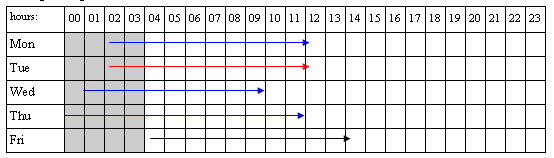
For simplicity, this example excludes breaks and periods of availability. In the above example, the start time reference point is 02:00. The 10 hour limit is complied with on Monday. However, an early start on Wednesday means the 10 hour rule is broken on Tuesday, as 11 hours work is performed in the 24 hour period starting at 02:00 hours on Tuesday. The 10 hour limit is complied with on Wednesday; despite an even earlier start on Thursday because only 10 hours work is performed during the 24 hour period. Again the 10 hour limit is complied with on Thursday, because only 10 hours work is performed during the 24 hour period in question.
4.4 Working Longer Than 10 Hours
More than 10 hours work at night can only be performed, if there is a relevant agreement in place. The amount of working time that can be performed is still restricted by the minimum rest requirements under European drivers' hours rules.
Frequently asked questions:
Q: Does the limit apply to you if you only occasionally work at night?
A: Yes, unless:
> you are an occasional mobile worker (see Section 1.3 - "occasional mobile worker"); or
> there is a relevant agreement that allows you to work longer than 10 hours in the 24 hour period.
Q: If I am a night worker under the Regulations, am I entitled to a health check under the 1998 Working Time Regulations?
A: In most cases the answer will be 'yes', but the right to health checks for night workers is governed by the 1998 Working Time Regulations, not these Regulations. The 1998 Working Time Regulations define: 'night time' as a period between 11pm and 6am - although this definition may be varied by a relevant agreement as long as the period is still 7 hours long and includes midnight to 5am; and a 'night worker' as someone who works for at least three hours during the night time period on the majority of their working days. This definition can also be varied by a relevant agreement. Further information on health checks for night workers can be found on the Department of Trade and Industry website at: www.dti.gov.uk.
5. Rest and Breaks
5.1 Main Points
> Minimum daily and weekly rest provisions under the existing European drivers' hours rules will continue to apply to drivers.
> The Regulations apply those same daily/weekly rest requirements to other mobile workers, trainees and apprentices when travelling in a vehicle within scope of the European drivers' hour rules.
> All mobile workers are subject to rest provisions under the European drivers' hours rules when travelling in in-scope vehicles.
> Break requirements under the Regulations, are in addition to those under the European drivers' hours rules.
The European drivers' hours rules break requirements take precedence when driving.
Employers check:
> That all mobile workers can take the rest and breaks they are obliged to take.
> That mixing driving with other work does not lead to a breach in the break requirements under the Regulations (see examples below).
5.2 Daily Rest
Drivers already have minimum daily rest requirements under the European drivers' hours rules. For any time spent driving a vehicle within scope of these rules, drivers are required to take 11 consecutive hours rest within the 24 hour period in question (calculated from the moment the driver commences work). This may be reduced to 9 consecutive hours up to 3 times a week. Alternatively a split daily rest period can be taken in two periods. The first period must be at least 3 hours, and the second at least 9 hours. Under the Regulations, identical daily rest requirements will also apply to other members of the travelling staff (e.g. crew, trainees and apprentices).
5.3 Weekly Rest
The European drivers' hours rules require that in any two consecutive weeks, a driver shall take at least two regular weekly rest periods, or one regular weekly rest period and one reduced weekly rest period of at least 24 hours. However, the reduction shall be compensated by an equivalent period of rest taken en bloc before the end of the third week following the week in question. A weekly rest period should start no later than at the end of six 24-hour periods from the end of the previous weekly rest period. These same weekly rest requirements also apply to any crew and travelling staff, travelling on in-scope vehicles. Rest requirements are additional to any paid annual leave entitlement that mobile workers are entitled to under the 1998 Working Time Regulations.
5.4 Breaks
The European drivers' hours rules require that after 4� hours driving, a driver must take a break of at least 45 minutes. This break may be replaced by a break of at least 15 minutes followed by a break of at least 30 minutes each distributed over the period. The break requirements under the Regulations will affect workers who do a mixture of driving and non-driving work. The rules on breaks will also apply on days when the mobile worker is not travelling.
The Regulations require that:
> Mobile workers must not work more than 6 consecutive hours without taking a break,
> If your working hours total between 6 and 9 hours, working time should be interrupted by a break or breaks totalling at least 30 minutes,
> If your working hours total more than 9 hours, working time should be interrupted by a break or breaks totalling at least 45 minutes,
> Breaks should be of at least 15 minutes duration.
In the interest of safety, and as a matter of good practice, it is strongly recommended that breaks should be distributed evenly throughout the day. When taking a break, drivers may not perform anything that might be regarded as "other work" during this period. Breaks taken under these Regulations may be taken at the workstation (typically this means the driver's cab - but see glossary for fuller definition of this and other terms).
Examples of Breaks: [3]
1. � hour other work + 4� hour driving triggers a 45 minute break under European drivers' hours rules. Another 4� hours driving triggers another 45 minute break under European drivers' hours rules. 9� hours of working under the Regulations would normally require 45 minutes break, but this has already been covered by the breaks taken under the European drivers' hours rules.
Total break time = 90 minutes.� hr other work, 4 � hours driving, � hour break, 4 � hours driving, � hour break, 1 hr other work
2. 4 hours other work + 2 hours driving triggers a break (30 minutes in this case) under the Regulations. Another 3 hours work (9 hours in total) and another 15 minute break is needed under the Regulations. There is no requirement to take any breaks under the European drivers' hours rules as total driving time has not reached 4 � hours.
Total daily break time = 45 minutes.4 hours other work, 2 hours driving, � hour break, 3 hours other work
� hour break, 1 hour other work
3. 3 hours driving + 2 hours other work + 1 hour driving will trigger a break (30 minutes in this case) under the Regulations. Another � hour of driving = 4� hours driving, requiring another 30 minute break under the European drivers' hours rules. This is because the second half of a split break taken under the European drivers' hours rules (which always takes precedent) must be at least 30 minutes long.
Daily break time = 60 minutes.3 hours driving, 2 hours other work, 1 hr driving, � hr break, � hr driving, � hr break, 3 hours driving
4. 3 hours driving + 2 hours period of availability + 3 hour other work triggers a break requirement under the Regulations (30 minutes in this case). Another 1� hours of driving = 4� hours driving, requiring a 30 minute break under the European drivers' hours rules. Again, this is because the second half of a split break taken under the European drivers' hours rules (which always takes precedent) must be at least 30 minutes long.
Daily break = 60 minutes. NB If all the conditions for a break are met, then a driver could take his mandatory break during the PoA.3 hours driving, 2 hours POA, 3 hours other work, � hr break, 1 � hours driving, � hr break, 2 hrs driving
5. The examples below shows two mobile workers A and B both working for 9 hours which means that their working time must be interrupted by a break or breaks totalling 30 minutes. The first example complies with the break requirements under the Regulations, the second does not.
Mobile worker A
6 hours other work, � hr break, 2 hours other work, � hr break, 1 hour other work, End of shift
6 hours consecutive other work triggers the break requirement under the Regulations. A break of at least 15 minutes must be taken. Mobile worker A then does another 2 hours other work, takes a break for 15 minutes and then completes another hour of other work before ending their shift. This complies with the Regulations as their working time is interrupted by breaks totalling 30 minutes.
Mobile worker B
6 hours other work, � hr break, 3 hours other work, � hr break - this is not legal the second break cannot be taken at the end of the shift, 6 hours consecutive other work triggers the break requirement under the Regulations. A break of at least 15 minutes must be taken. Mobile worker B then does another 3 hours other work before taking his second 15 minute break at the end of their shift. This does not comply with the Regulations as their working time has not been interrupted by breaks totalling 30 minute. It has only been interrupted by a break of 15 minutes. If the mobile workers were to work longer than 9 hours than total breaks for the day would be 45 minutes.
Frequently asked questions:
Q: Do these breaks count towards the working time of mobile workers.
A: No. Whether paid or unpaid, breaks do not count towards any of the limits under the Regulations.
Q: How are breaks calculated when a driver has also taken a period of availability?
A: Breaks requirements under the Regulations are triggered by the amount of working time that is performed, rather than the length of shift or attendance time (see example 4). In addition, there is nothing to prevent a mobile worker from taking a break in the middle of a period of availability, as long as they meet all the appropriate requirements for taking a break, and that breaks are recorded separately for enforcement purposes.
Q: Can I take one of my breaks at the end of my shift?
A: No. The Regulations require that working time must be "interrupted" by your breaks. In effect, this means that you must resume work after any breaks have been taken. [3] Note: If "other work" consists of driving under UK Drivers' Hours rules, then additional break requirements may apply.
6. Record Keeping
6.1 Main Points
> Records need to be kept for 2 years after the end of the period in question.
> The employer is responsible for keeping working time records, making the records available for inspection and informing employees of their responsibilities. Employees must see the details of any relevant agreement in advance.
> Employment agencies/Employment businesses should keep working time records if the mobile worker is paid by (or via) them.
> Mobile workers are responsible for notifying an employer (in writing) of work performed for another employer.
> Owner drivers who do not meet the criteria for a self-employed driver under the Regulations should keep a record of their own working time.
Employers check:
> Inform employees of their rights under the Regulations, together with details of any relevant agreements.
> Notify employees that they must provide (in writing) an account of any working time they have performed for another employer.
> Decide which records/systems you are going to use to record working time.
If tachograph records are used:
> a separate record of working time will be required if the mobile worker is not travelling that day.
> (where necessary) Check that the agency or employment business has had the opportunity to copy the tachograph chart, so they can keep a record of working time performed by their drivers.
6.2 Who Keeps a Record of Working Time?
The employer keeps records of working time and other relevant information, such as a copy of any relevant agreement. Where a driver is paid directly by an agency or employment business rather than by one or more employers, the agency or employment business should keep a record of the working time. Under the Transport Act 1968 tachograph records go to employers rather than agencies. If tachograph records are going to be used to monitor working time, then the agency or employment business should obtain a copy of the chart from the driver before returning it to the client. Drivers and other workers who do not meet the criteria of a "self-employed driver" under the Regulations, but are not employed, nor do they work via an agency, will need to keep their own record of working time. These records need to be kept for 2 years and should demonstrate that the worker is complying with both sets of weekly limits, the 10 hour night work limit and the minimum break and rest requirements.
Testimonials
Customer Satisfation Guarentee
If you are not completely satisfied with the products you purchase from us, return them in their undamaged, original packaging within the first 60 days of receipt, and we will send you a full refund.